Seachem Matrix Bio Media 250ml Review (2026)
Updated September 14, 2026 · Research-based review
Our verdict
A dependable biological media for a nano or small canister filter that wants strong ammonia and nitrate handling from a small volume. Seachem's Matrix is porous enough to host both nitrifying and denitrifying bacteria at once, though the 250ml size fills only a modest tray and costs more per liter than basic ceramic rings.
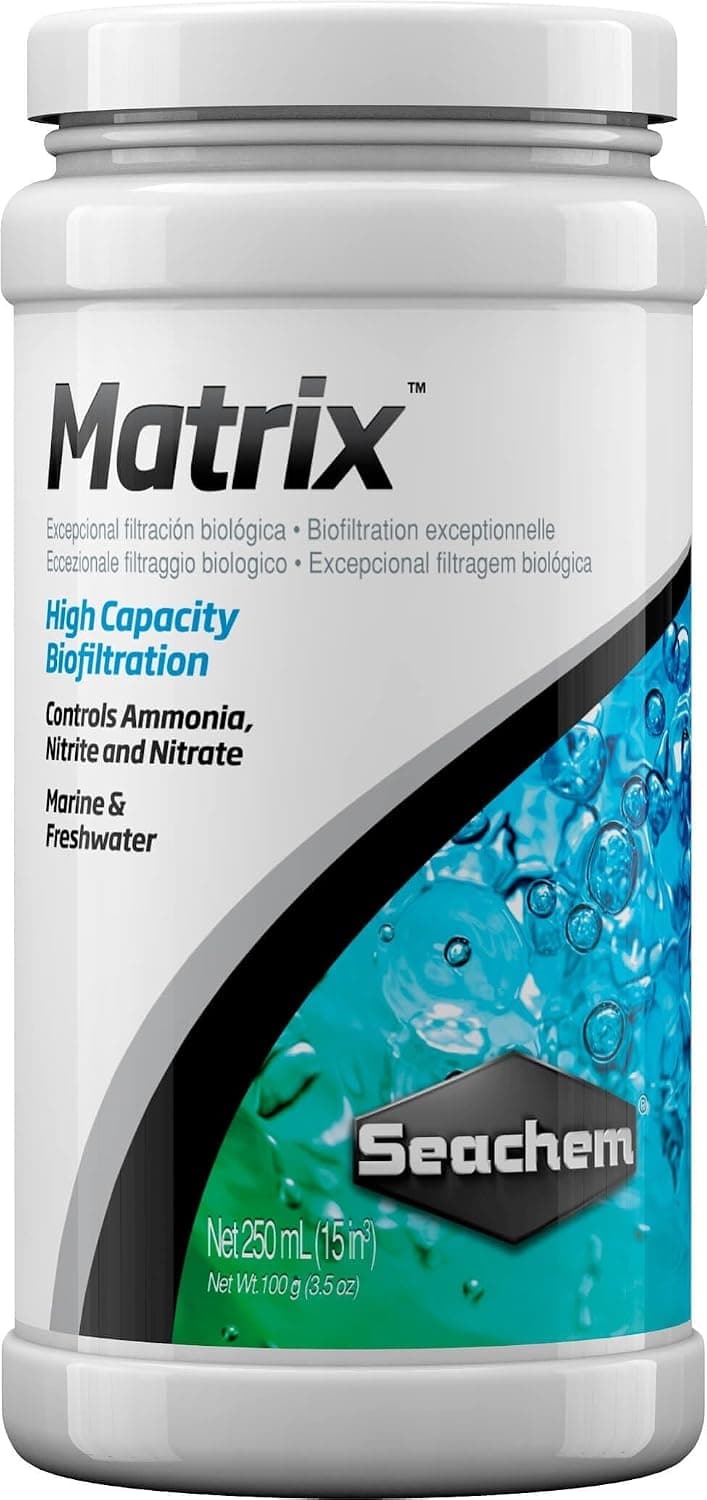
Seachem Matrix bio media in a 250ml container, a porous stone media sized for nano filters and small canisters.
Price range: See on Amazon
What we liked
- + Highly porous stones host bacteria inside as well as on the surface
- + The 250ml size fits nano canisters and all-in-one tank chambers
- + Inert media does not alter pH, so it suits soft water planted tanks
Trade-offs
- - Small container fills only a modest tray in a larger filter
- - Costs more per volume than basic ceramic rings
Who this size of Matrix suits
The 250ml container is sized for a nano canister filter, a small all-in-one tank's media chamber, or as a top-up addition to an existing biological media stack rather than as the sole media for a large aquarium. Seachem's own dosing guidance calls for roughly 250ml of Matrix per 200 liters, or about 50 US gallons, of water, which puts this smallest size squarely in nano and small tank territory. Someone running a larger tank, such as 40 gallons or more, would need multiple containers or a larger size to reach that ratio, while a keeper with a compact planted nano tank or a small canister filter gets a properly scaled amount from this single 250ml bag without paying for volume they cannot use.
What makes the media itself different
Matrix is a naturally mined, chemically inert porous stone roughly 10mm across, and its defining feature is the macroporous structure running through each piece rather than just across its surface. Seachem states that each liter of Matrix offers roughly 700 square meters of surface area, comparable to what 170 liters of plastic bio-balls would provide, because bacteria can colonize the internal pore structure as well as the outer surface. That internal porosity is large enough to support both nitrifying bacteria, which handle ammonia and nitrite, and denitrifying bacteria deeper inside the pores, which can process nitrate in the same piece of media. Because the material is inert, it does not alter pH or water chemistry, which makes it a reasonable fit for both soft water planted tanks and harder water community setups.
Getting it into a filter and maintaining it
Matrix works in essentially any filter type with a media chamber or basket, though Seachem notes it performs particularly well in canister filters where water is forced through the media bed rather than simply flowing past it. A mesh media bag makes it easy to load into a canister tray or a nano filter's chamber and just as easy to lift out during maintenance without spilling loose stones. Because the material does not physically break down, Seachem states it does not need periodic replacement the way carbon or other chemical media do, so maintenance is limited to an occasional light rinse in tank water to clear physical debris without scrubbing away the bacterial colonies that make it effective in the first place.
How it compares with other biological media
Against Biohome's Ultimate media, which markets a similarly porous structure aimed at both nitrifying and denitrifying capacity, Matrix is priced lower per unit volume in the smaller sizes but does not include some of the specific mineral additives Biohome advertises. Compared with basic ceramic rings or bio balls, which are considerably cheaper, Matrix costs more per liter but claims a meaningfully larger surface area from the same volume thanks to its internal pore structure rather than just external surface. For a keeper prioritizing maximum biological capacity from a small media tray, that surface area advantage is usually the deciding factor over the higher per-liter price of basic ceramic alternatives.
Verdict and when to size up
For a nano tank, small canister filter or an all-in-one system needing biological media in a compact volume, this 250ml size is correctly scaled and delivers the porous structure Matrix is known for without paying for a larger container than the tank needs. That precise fit for small setups is the main reason it scores well despite the higher price per liter than basic ceramic media. Anyone stocking a larger aquarium, generally 40 gallons and up, should buy one of Seachem's bigger container sizes or multiple 250ml bags to reach the recommended dosing ratio rather than relying on a single small bag.
Frequently asked questions
How much Seachem Matrix does a tank need?
Seachem recommends roughly 250ml of Matrix per 200 liters, or about 50 US gallons, of aquarium water, so tank size should guide how many containers to buy.
Does Matrix need to be replaced like carbon or other chemical media?
No, Seachem states Matrix is chemically inert and does not break down, so it does not need periodic replacement the way carbon or resin media do.
Can Matrix handle both ammonia and nitrate?
Yes, its internal pore structure is large enough to host nitrifying bacteria near the surface for ammonia and nitrite, and denitrifying bacteria deeper inside the pores for nitrate.
Is the 250ml size big enough for a standard 20 to 30 gallon tank?
It is on the small side for that range under Seachem's recommended ratio, so pairing it with additional Matrix or another biological media is worth considering for tanks over about 20 gallons.
Prices change often, so check the current price and availability on Amazon.
Check price on AmazonAquascape Nest may earn a commission from the link above.