API GH & KH Test Kit, Freshwater Aquarium, 2.5 oz Review (2026)
Updated September 14, 2026 · Research-based review
Our verdict
A focused liquid test kit for general hardness and carbonate hardness, useful for shrimp keepers and anyone dialing in CO2 injection off a KH baseline. It only covers hardness, so it needs to be paired with an ammonia, nitrite and nitrate kit for full water quality tracking.
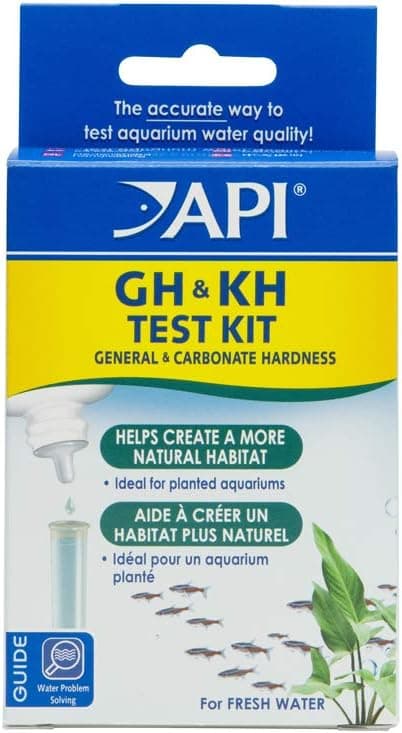
API GH and KH Test Kit in 2.5 oz, a liquid test for general and carbonate hardness in freshwater tanks.
Price range: See on Amazon
What we liked
- + Measures GH and KH, key for shrimp and plant health
- + Drop-count method is simple and repeatable
- + Helps set up CO2 injection with KH knowledge
Trade-offs
- - Only tests hardness, not ammonia or nitrate
- - Drop counting can be tedious for high hardness
Who this kit is for
This kit is built for freshwater keepers who specifically need to track general hardness, GH, and carbonate hardness, KH, two parameters that a standard ammonia and nitrate focused master kit does not cover. Shrimp keepers rely on GH and KH readings heavily, since many shrimp species are sensitive to hardness swings and need water parameters held in a narrow, species-appropriate range. Planted tank keepers running pressurized CO2 also use KH as part of calculating how much CO2 is dissolved in the water relative to pH, making this kit a practical companion for anyone tuning a CO2 injection setup. It is not a substitute for a full master test kit, since it does not test ammonia, nitrite, pH or nitrate on its own.
What is in the box and test capacity
The kit includes two reagent bottles, a printed color chart card and two glass test tubes with caps, according to retailer listings for the product. Retailer estimates put the combined GH and KH test capacity at roughly 160 tests depending on how the reagents are split between the two parameters, since each test type draws from its own bottle. Testing uses a drop-count method: you add reagent drop by drop to a water sample and count how many drops it takes for the color to change, with the drop count itself, not just a color match, giving you the hardness reading in degrees. This makes the kit different in method from the more common color-chart comparison approach used in ammonia or nitrate testing.
Running it and reading results
Because the test relies on counting drops until a color change occurs, rather than comparing a fixed color against a chart, testing very hard water samples can mean counting a large number of drops, which some owners find tedious compared with a simple visual color match. GH and KH do not typically swing as fast as ammonia or nitrite in a cycling tank, so this kit is usually run less frequently, often used to establish a baseline reading and then rechecked periodically or after a substrate or major water source change. Shrimp keepers monitoring hardness closely for species-specific ranges may test more often, particularly after adding remineralizer products or switching water sources. Keeping the two reagent bottles capped tightly between uses helps preserve reagent accuracy over the life of the kit.
How it compares with other test kits
In the site's water test kit guide this kit ranks third of seven, behind both the 800-test and standard versions of the API Freshwater Master Test Kit, which cover a broader panel of parameters including ammonia, nitrite, nitrate and pH alongside more total tests. It ranks ahead of test strip options such as Tetra EasyStrips and API's saltwater-focused kits, which are not directly comparable since they serve different water types or testing methods. The practical takeaway from the guide's ranking is that this kit is best used to complement a master test kit's ammonia and nitrate coverage with dedicated hardness tracking, rather than as a standalone first purchase for a brand new tank.
Trade-offs and who should pair it with another kit
The clearest limitation is scope: this kit tests only GH and KH, so anyone setting up a new tank and needing to monitor ammonia, nitrite and nitrate during cycling will need a separate master test kit alongside this one. The drop-count method also takes more patience with harder water samples, where dozens of drops may be needed before a color change appears. For shrimp keepers, CO2 injection users, or anyone who already owns an ammonia and nitrate kit and wants to add hardness tracking, this kit fills that gap well and earns our score of 8.3 out of 10 for doing its specific job reliably.
Frequently asked questions
Does this kit test ammonia or nitrate too?
No, this kit only measures general hardness, GH, and carbonate hardness, KH; ammonia, nitrite, nitrate and pH require a separate kit such as the API Freshwater Master Test Kit.
How many tests are in the API GH & KH Test Kit?
Retailer estimates put the combined GH and KH test capacity at roughly 160 tests total, split between the two reagent bottles.
Why do I need to know my KH if I run CO2 injection?
Carbonate hardness, KH, is used together with pH to estimate dissolved CO2 in the water, which helps planted tank keepers dial in safe and effective CO2 injection levels.
How does the drop-count testing method work?
You add reagent to a water sample one drop at a time and count the drops until the color changes; the number of drops corresponds to the hardness reading, rather than matching a single color against a chart.
Prices change often, so check the current price and availability on Amazon.
Check price on AmazonAquascape Nest may earn a commission from the link above.