Thrive+ All in One Liquid Aquarium Plant Fertilizer 500ml Concentrated Review (2026)
Updated September 14, 2026 · Research-based review
Our verdict
Thrive+ is NilocG's concentrated all in one liquid fertilizer for high-tech planted tanks running strong lighting and CO2 injection, dosed at 1 ml per 5 gallons up to three times a week. It packs a dense nutrient load high demand tanks use quickly, but that concentration can overshoot in a low-tech tank without CO2.
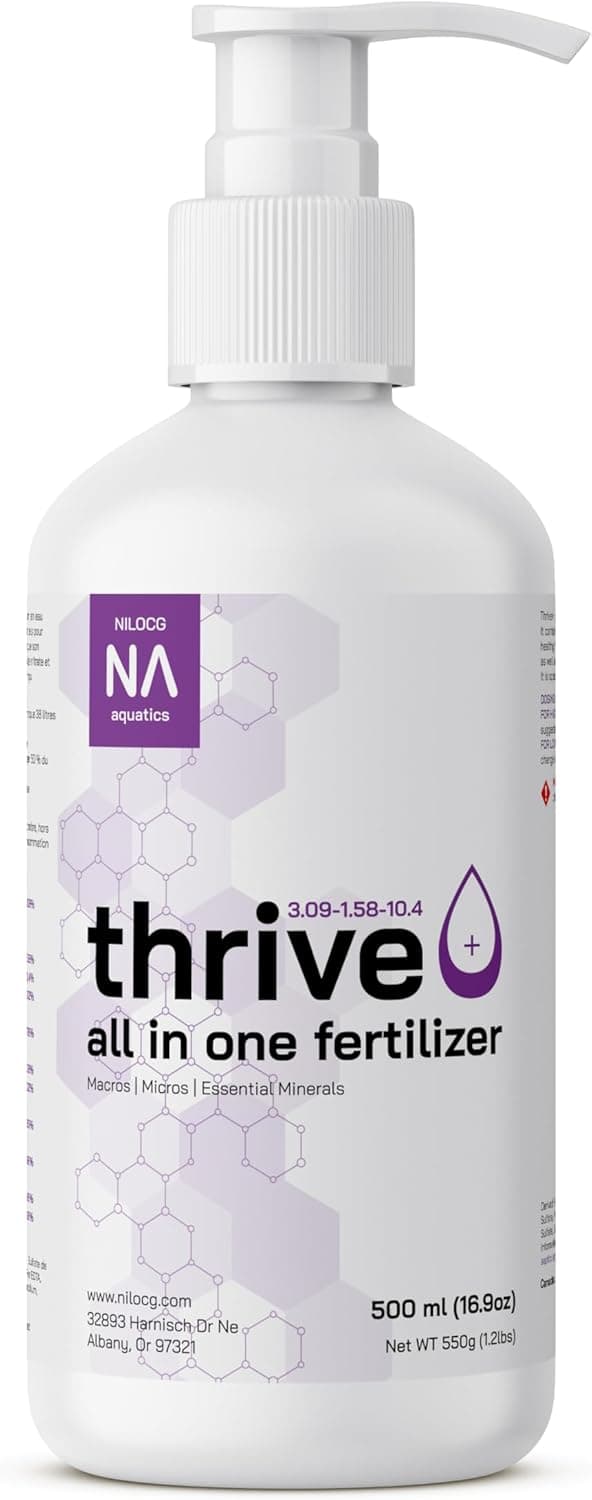
Thrive+ all in one concentrated liquid fertilizer in 500ml, a stronger formula for high-tech planted tanks.
Price range: See on Amazon
What we liked
- + Concentrated formula makes the 500ml bottle last a long time
- + Thrive+ is aimed at high-tech tanks with CO2 and strong lighting
- + All in one dosing keeps fertilizer routines simple
Trade-offs
- - Too strong for low-tech tanks, which can trigger algae
- - Concentrated dosing requires careful measuring for small tanks
Who Thrive+ is built for
This fertilizer is formulated for higher demand planted aquariums, specifically tanks running strong lighting and CO2 injection where plants are growing fast enough to use up nutrients quickly. NilocG's own dosing guidance calls for high-light tanks to dose 1 ml per 5 gallons up to three times a week alongside a 50 percent weekly water change, which is a pace suited to fast growing stem plants and carpeting species rather than a lightly stocked low-tech setup. Anyone running a CO2 injected tank who has outgrown a basic all in one fertilizer and needs a more concentrated nutrient supply is the target buyer.
What is actually in the bottle
According to NilocG, Thrive+ carries an NPK ratio of 3.09-1.58-10.4 along with 0.65 percent chelated iron and a spread of secondary and micronutrients including magnesium, sulfur, boron, copper, manganese, molybdenum and zinc. The manufacturer notes two forms of nitrogen are included to support growth, and the 500 ml pump bottle is concentrated enough to dose roughly 2,500 gallons of water over time at the standard rate. NilocG also advises caution if tank pH is above 7, since some of the nitrogen source can convert toward ammonia at higher pH, which is worth checking before dosing heavily in a hard, alkaline water tank.
Dosing routine and water changes
The recommended routine ties dosing frequency to light intensity: high-light tanks dose three times weekly with a 50 percent weekly water change, while lower-light tanks dose once or twice a week paired with a smaller 20 to 30 percent change. Because the pump bottle delivers roughly 1 ml per pump, dosing stays simple day to day once the routine is set, though owners running CO2 need to keep gas levels consistent alongside the extra nutrients, since fertilizer without adequate CO2 can push a tank toward algae rather than plant growth. The bottle is also sold in 2000 ml and 4000 ml sizes for larger tanks or fish rooms, which is worth checking before buying several 500 ml bottles back to back for a big setup, since the larger sizes work out cheaper per dose over a full year of regular dosing.
How it compares with the rest of the lineup
In the site's liquid fertilizer guide Thrive+ ranks first of eight, just ahead of NilocG's own low-tech Thrive C formula, a two bottle Thrive+ bundle, the pump-bottle Thrive All-in-One and competing concentrated formulas. Against Thrive C specifically, the difference comes down to concentration and target tank: Thrive+ carries meaningfully more nitrogen, phosphate and potassium per dose, matching the faster uptake of a high-tech tank, while Thrive C is built with lighter nutrient levels for tanks without CO2 or strong lighting. Picking between the two is less about brand loyalty than about what the tank's plants can actually use, since dosing the stronger Thrive+ formula into a slow growing low-tech setup risks feeding algae instead of the plants it is meant for.
Trade-offs and verdict
The concentrated formula that makes Thrive+ efficient for high-tech tanks is also its main risk in the wrong setup: dosing this strength into a low-tech tank without CO2 and strong light can supply more nutrients than the plants are actually using, since slower growth cannot absorb the same load a CO2 injected tank can. Owners with a lightly stocked, low-tech tank should reach for Thrive C instead, while high-tech, CO2 injected planted tanks get real value from Thrive+'s dense nutrient profile and long-lasting concentrate. Within its intended use, it earns our score of 8.6 out of 10.
Frequently asked questions
How often should I dose Thrive+?
NilocG recommends 1 ml per 5 gallons up to three times a week for high-light tanks, or one to two times weekly for lower-light setups, paired with regular water changes.
Is Thrive+ safe for shrimp tanks?
NilocG states it is suitable for shrimp tanks when dosed as directed, though it is not a formula specifically designed around shrimp needs.
What is the difference between Thrive+ and Thrive C?
Thrive+ carries a stronger NPK ratio built for high-tech tanks with CO2 and strong lighting, while Thrive C uses lighter nutrient levels for low-tech tanks without CO2.
Can I use Thrive+ in a tank with pH above 7?
NilocG advises caution at pH above 7, since part of the nitrogen source can convert toward ammonia at higher pH levels.
Prices change often, so check the current price and availability on Amazon.
Check price on AmazonAquascape Nest may earn a commission from the link above.