Thrive C Liquid Aquarium Plant Fertilizer All in One for Low Tech Tanks 500ml Review (2026)
Updated September 14, 2026 · Research-based review
Our verdict
Thrive C is NilocG's all in one liquid fertilizer built for low-tech planted tanks without CO2 injection, dosed at 1 ml per 5 gallons once or twice a week. Its lighter nutrient ratios reduce the risk of dosing more than slow plants can use, but tanks running CO2 and strong lighting will outgrow it.
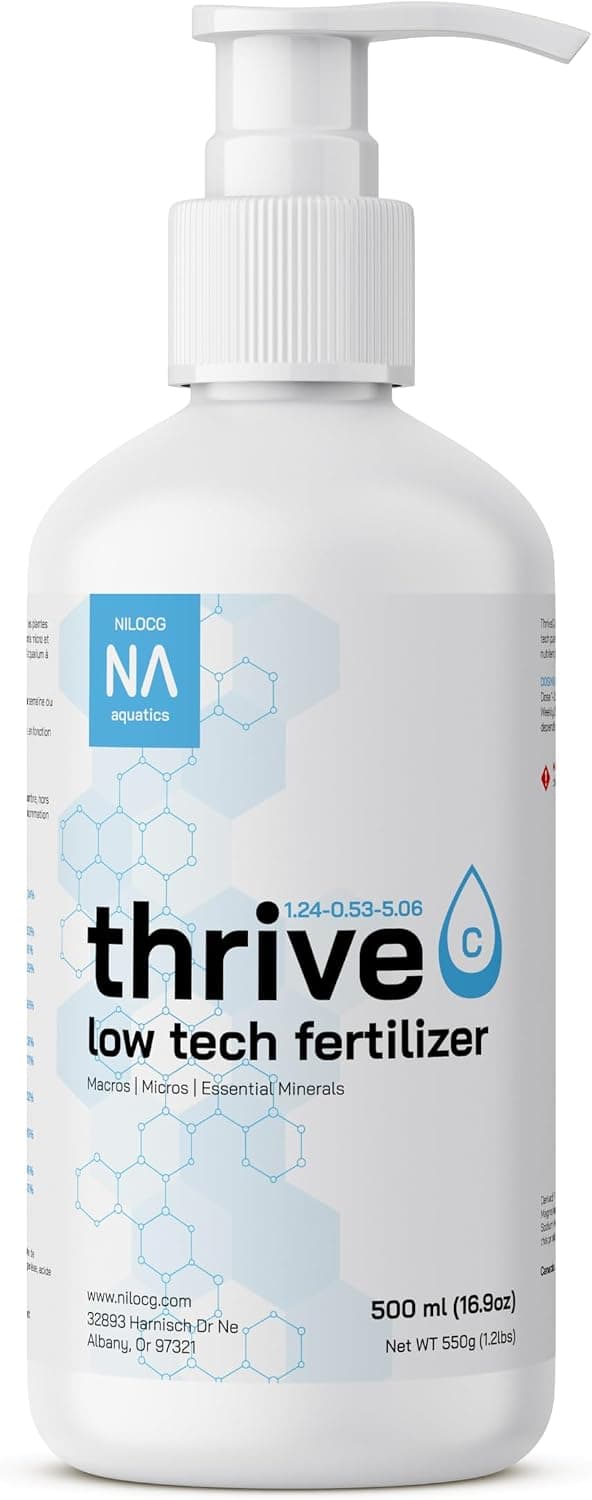
Thrive C all in one liquid fertilizer for low tech tanks in 500ml, a gentler formula for tanks without CO2.
Price range: See on Amazon
What we liked
- + Formulated for low tech tanks, reducing the risk of nutrient excess
- + All in one formula keeps plant care simple
- + The 500ml bottle lasts a long time at low tech doses
Trade-offs
- - Not enough nutrients for high-light CO2 injected tanks
- - Liquid fertilizers still need root tabs for heavy root feeders
Who Thrive C is built for
Thrive C is formulated for lower-tech planted aquariums with moderate nutrient demand, meaning tanks running typical lighting without CO2 injection and slower growing plant species like anubias, java fern or crypts. NilocG's dosing guidance calls for 1 ml per 5 gallons once or twice a week, a noticeably gentler routine than a high-tech fertilizer, paired with a 20 to 30 percent weekly water change that can be scaled back depending on the tank's specific needs. Anyone running a low maintenance planted tank who wants consistent nutrients without the algae risk that comes from overdosing a concentrated high-tech formula is the target buyer.
What sets its nutrient profile apart
According to NilocG, Thrive C carries an NPK ratio of 1.24-0.53-5.06, along with magnesium, sulfur and chelated micronutrients including iron, manganese, boron, zinc, molybdenum and copper. That is a meaningfully lighter nitrogen and phosphate load than the company's own Thrive+ formula, reflecting that low-tech tanks without CO2 grow more slowly and cannot use up a high-tech level of nutrients before they build up in the water column. At a slightly higher dose, roughly 2 ml per 10 gallons, NilocG states the formula adds approximately 6 ppm nitrate, 1.1 ppm phosphate, 5 ppm potassium and 0.25 ppm iron, giving owners a way to fine tune dosing against their own water tests.
Dosing routine for a low-tech tank
The suggested routine of dosing once or twice weekly alongside a 20 to 30 percent water change fits well with the slower pace of a low-tech tank, where plants are not pulling nutrients as quickly as a CO2 injected setup would. Because the bottle uses a pump dispenser delivering roughly 1 ml per pump, day to day dosing is simple to keep consistent, and NilocG notes the water change percentage can be reduced depending on the specific tank's needs rather than following a fixed schedule. The 500 ml bottle is rated to dose up to 2,500 gallons of water at the standard rate, and is also sold in 2000 ml and 4000 ml sizes.
How it compares with Thrive+ and other fertilizers
In the site's liquid fertilizer guide Thrive C ranks second of eight, just behind NilocG's own high-tech Thrive+ formula and ahead of a two bottle Thrive+ bundle, the pump-bottle Thrive All-in-One and other concentrated competitors. The core difference from Thrive+ is concentration rather than ingredients: both use a similar nutrient spread, but Thrive C's lighter NPK ratio is built to match what a low-tech tank's slower growing plants can realistically absorb, reducing the chance of nutrients accumulating and feeding algae instead of plants. Choosing between the two mainly comes down to whether CO2 is being injected, rather than personal preference, since dosing the stronger Thrive+ into a tank without CO2 defeats the point of picking the gentler formula in the first place.
Trade-offs and verdict
The trade-off of a gentler formula is that it will not keep up with a high-light, CO2 injected tank full of fast growing stem plants, which will pull through Thrive C's lighter nutrient load faster than it can be replenished at the recommended dose. Owners in that situation should switch to Thrive+ rather than simply dosing Thrive C more often. For a low-tech tank running typical lighting and no CO2, however, Thrive C strikes a sensible balance of consistent nutrition without excess, and it earns our score of 8.6 out of 10. Liquid fertilizer alone still will not fully feed heavy root feeding plants, which generally also benefit from root tabs in the substrate.
Frequently asked questions
How often should I dose Thrive C?
NilocG recommends 1 ml per 5 gallons once or twice a week for low-tech tanks, paired with a 20 to 30 percent weekly water change.
Is Thrive C strong enough for a CO2 injected tank?
It is formulated for lower-tech tanks without CO2, so a high-light, CO2 injected tank with fast growing plants will likely need the stronger Thrive+ formula instead.
Is Thrive C safe for shrimp?
NilocG lists it as safe for freshwater planted tanks containing shrimp when dosed as directed.
How much nitrate and phosphate does Thrive C add per dose?
NilocG states that roughly 2 ml per 10 gallons adds about 6 ppm nitrate, 1.1 ppm phosphate, 5 ppm potassium and 0.25 ppm iron.
Prices change often, so check the current price and availability on Amazon.
Check price on AmazonAquascape Nest may earn a commission from the link above.