JARDLI Glass CO2 Drop Checker Monitor Kit for Planted Tank (with Solution) Review (2026)
Updated September 14, 2026 · Research-based review
Our verdict
The JARDLI glass CO2 drop checker suits planted tank owners who want a ready-to-use monitor rather than a bare glass shell. It ships with indicator solution already in the box, but the glass is delicate around the suction cup and color reads can be hard to judge under colored LED light.
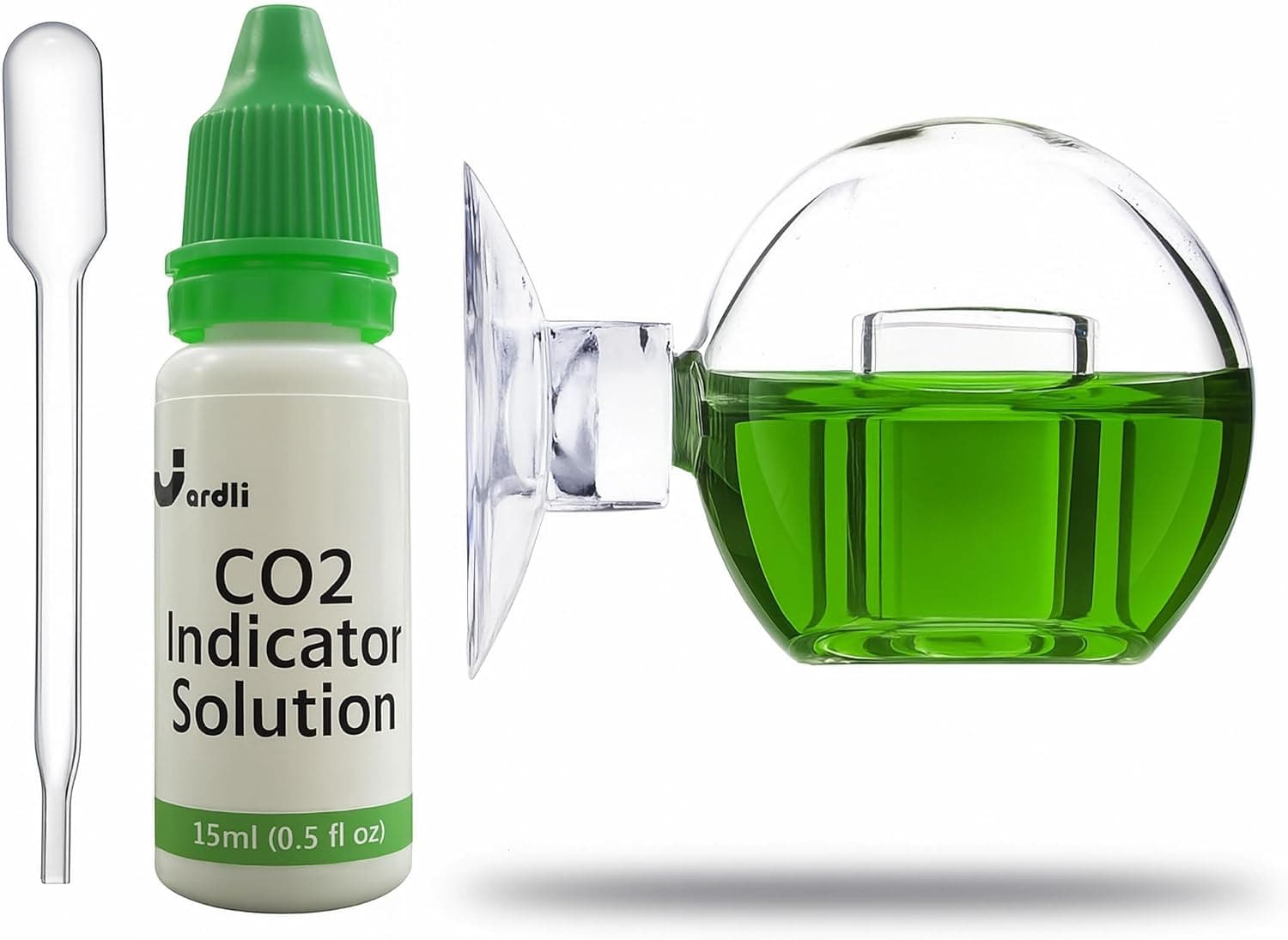
JARDLI glass CO2 drop checker monitor kit with solution, a trusted glass checker for tracking planted tank CO2.
Price range: See on Amazon
What we liked
- + Solution included, so it is ready to fill and use immediately
- + Clear glass shows color changes easily from the front
- + JARDLI glassware matches their diffusers and lily pipes
Trade-offs
- - Fragile glass can break when removing suction cups
- - Color reading is subjective under strong RGB lighting
Who this drop checker fits
This is a fill-and-go option for anyone dosing pressurized or liquid CO2 into a planted tank and wanting a visual check on whether levels are on target. Because the kit already includes indicator solution, a pipette and two suction cups, it suits a first-time CO2 user who does not want to buy reagent separately or measure it out. It is less useful on its own for someone chasing exact dKH numbers, since a drop checker only gives a color range rather than a precise reading. Anyone running CO2 on a nano tank or a larger display where fish and shrimp share the water will get the most value, since the checker acts as an early warning before CO2 climbs high enough to stress livestock overnight.
How the glass and solution work
The unit is a laboratory grade borosilicate glass bulb that hangs inside the tank on a suction cup, with a wide fill channel that makes it easier to pour in solution without spilling. You fill the chamber about half full with the supplied indicator, which sits in a trapped air pocket separated from the tank water by a thin water barrier so it reacts to dissolved CO2 rather than the water itself. Color shifts slowly because gas has to diffuse across that barrier, so readings lag real time levels by roughly one to two hours. Green signals an acceptable range, blue signals CO2 is too low, and yellow signals CO2 is running too high for comfort.
Setting it up and living with it day to day
Placement matters more than most owners expect. Mounting the checker near the outflow of a filter or diffuser gives a faster, more representative reading than a corner with still water, and keeping it away from direct light helps you judge the green, blue or yellow color without a colored tint from LEDs skewing your eye. Because the reading is delayed, it works best as a trend tool checked once or twice a day rather than a moment-to-moment gauge, paired with a controller or timer if you are chasing consistent CO2. The solution needs replacing every few weeks as it becomes less responsive, and the suction cups should be pressed on gently since the glass around the mounting point is a common failure spot.
Trade-offs and how it compares
Against the NilocG Aquatics drop checker, which many hobbyists rate slightly higher for reagent consistency, the JARDLI kit wins mainly on convenience since it arrives pre-filled and ready to hang rather than needing you to source or mix your own 4dkh solution. Compared with the Clscea combination diffuser and checker, the JARDLI is a simpler, single-purpose tool, which some keepers prefer because it is easier to reposition without disturbing a diffuser. The core trade-off across this whole product category is the same: color reading is inherently subjective, two people can disagree on whether a checker looks green or green-blue, and the fragile glass around the suction point can crack if you twist it off carelessly.
Verdict and who should look elsewhere
For a planted tank keeper who wants a low-cost, no-mixing way to sanity-check CO2 dosing, this drop checker earns its place, and it lines up with our score of 7.9 out of 10 for being a solid, uncomplicated tool rather than a premium instrument. Owners who need precise, real-time CO2 numbers for a delicate high-tech scape are better served by a pH controller or inline CO2 monitor that reads continuously instead of on a lag. Anyone who has previously cracked a glass drop checker while removing it for cleaning should handle the suction cup release carefully or consider a plastic-bodied alternative instead.
Frequently asked questions
How long does it take for a CO2 drop checker to change color?
Expect roughly one to two hours for the indicator solution to fully react to a change in dissolved CO2, since gas has to diffuse across the water barrier inside the glass before the color shifts.
What color should the drop checker be for safe CO2 levels?
A green solution generally signals an acceptable CO2 range for a planted tank, while blue points to too little CO2 and yellow points to too much.
How often do I need to refill the indicator solution?
Most owners replace the solution every few weeks once color changes become sluggish or the liquid looks cloudy, since the reagent weakens with repeated CO2 exposure.
Where in the tank should I place the drop checker?
Mount it near the filter outflow or CO2 diffuser rather than a still corner, since flowing water gives a faster and more representative reading of the CO2 level in the main body of the tank.
Prices change often, so check the current price and availability on Amazon.
Check price on AmazonAquascape Nest may earn a commission from the link above.